You are viewing articles in the category: Design
An open letter to Oxford Dictionaries and Handmark software on the state of the Oxford iOS apps
[My apologies if this has reached you in error. Writing to large corporations can feel like yelling in the wind, so I’m cc’ing a number of emails in hopes that one may reach a sympathetic ear. Please consider forwarding this to someone who can do something about it.]
Dear Gents:
I’ve purchased several of your iPhone and iPad apps, including the New Oxford American Dictionary. I’m a big fan of the dictionary’s actual definitions, but not a big fan of the app itself. Most frustrating is how many taps it takes from launching the app to getting to look up a word. It’s (1) launch, (2) wait for the search command to appear, (3) tap search (a TINY button?!), (4) tap inside the search box, and (5) tap to delete the previous word looked up.
Un-reasonable, especially for a $29.99 app. If I were making suggestions to you, I’d recommend the app to automatically look up a word if one is in the device’s clipboard, and offer a blinking cursor in a search field upon launch otherwise.
Recently I was looking for a thesaurus app, and noticed your Writer’s Thesaurus. As much as I’d like to own this app ($24.99), I cannot buy it after reading some of the reviews. There’s content missing from the app that exists in the book? There are mini-essays throughout the app that can only be found by stumbling on them? And, most devastatingly, the search is no better than the dictionary app? Sorry, I’ll have to stick to the web browser for word discovery.
I hope you’ll invest some time and energy into improving these (expensive!) apps, so that the user interface is as useful and engaging as the content. And I hope you’ll write me back with your plans in this regard, so I can either begin to wait in anticipation, or put my hopes to rest.
Yours truly,
Alesh Houdek
Update: I actually received a response from Park Jacobs at Handmark (the software partner that produces Oxford University Press’ apps) almost immediately, but haven’t gotten a chance to respond to him or post it until now. Shame on me. Here it is:
Hi Alesh,
My Name is Jacob Park and I am the product manager at Handmark responsible for the Oxford dictionaries on mobile clients. I’d like to thank you for your feedback. We’re always looking to improve the user experience and your feedback is critical.
Your suggestion for automatically searching for text in the clipboard is great and a feature that has been added to the to-do list. The loading time you are seeing while waiting for the search command to appear on launch is a result of some libraries being loaded that are required for the ‘fuzzy’ search functionality. I am looking into what we can do to speed that up to reduce the time from launch to search. The search process you describe below seems to reflect the user experience of the iPad app functioning in portrait mode. Is that correct? I think there may be some relatively easy fixes we can get in that would improve the search functionality, particularly on the iPad, like assuming the user wants to execute a new search when the app is brought to the foreground – clearing out the previous text and displaying the search popover automatically with the search field active. I’ll put these in the feature list for the next point release of the application.
Again, thanks for the feedback. It really is appreciated.
Regards,
Jacob
Posted: Monday November 28, 2011 by Alesh Houdek · Permalink · Comment
Infographic: 10 charts about sex from the always interesting OK Cupid blog.
I'm on a panel: "New Paradigms in Communicating Design Culture"
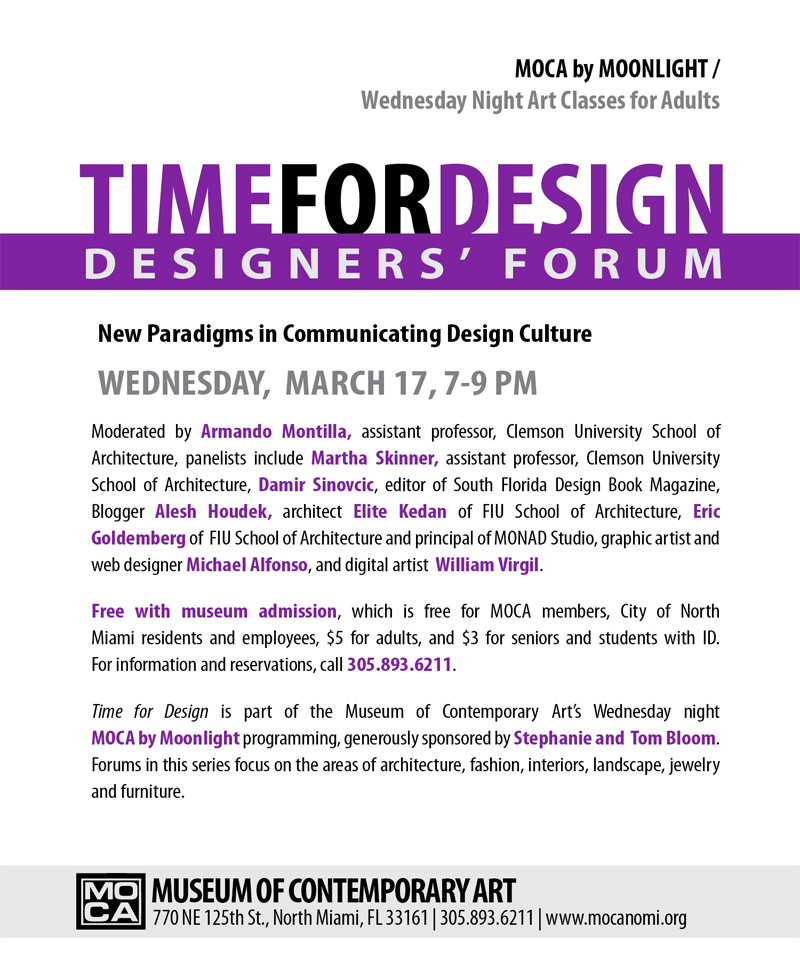
This Wednesday I’ll be part of a panel discussion, and no, it’s not at SXSW. It’s at MoCA, and it’s about, I guess, contemporary digital design, social media, and architecture? The info is on Facebook, I’m reproducing it here for those who haven’t seen it. There’s also an e-flyer, and here is the sparsely populated MoCA link. Come by and say hi!
New Paradigms in Communicating Design Culture
‘Time for Design’ Panel Discussion at MOCA – moderated by Armando Montilla7 pm, Wednesday, March 17, 2010
Museum of Contemporary Art, North Miami
770 NE 125th Street North Miami, FL 33161Traditional ways of communicating design though printed media now share their role in communicating the culture of design with subversive/alternative publishing means such as blogs and social networks sites. Physical versus virtual, high-institutionalized versus low-alternative; and individual versus collaborative are the new paradigms in communicating design culture in times of financial challenges.
This event will suggest Mediation and Subversion as means of spreading Design Culture, in the format of discussion panel with short (5 min. max.) visual presentations included, within the frame of the ‘Time for Design’ Discussion Panel Events at MOCA.
The underlined questions of the discussion will be:
1. Can we go beyond traditional means of mediation in architectural design such as printed publications?
2. Can we promote a good design-oriented culture through the use of Internet blogging at the present lacking of available funding to produce publications?
3. What could the role of sub-cultures in the city to promote ‘unappreciated’ aspects of innovative design?
4. How can we have a participative ‘design community’ exchange using virtual/non-traditional means?
5. How can we activate community participation in collective design efforts?
The discussion will also aim to: “[The] identif[ication of] different actors in the mediation process of the city, particularly in what refers to the realm of contemporary artists, urban hackers and para-architects dealing with media and the city…[..]…‘Wiki’ collaborative modes and ‘Smart Mob’ organizational strategies, not only lead to physical manifestations in real space – such as the so-called ‘Flash Mobs’ – but also enable bottom-up, edge-in social innovation in times of financial hardship and environmental consciousness. How are these platforms envisioned by designers today in search of social impact in the city? What are architects to learn from the field of contemporary art at the level of capacity to mediate with different actors in the city? …[…]…how can designers learn from the latest field of digital techniques and prototyping, in order to allow collective authorship to come into the realm of collaborative design?” Link
List of Panelists:
1. Damir Sinovcic, Editor, South Florida Design Book Magazine and Principal of Liquid Design in MIami
2. Elite Kedan, Architect, Faculty at FIU School of Architecture, Editor of the recent Book: Provisional: Emerging Modes of Architecture Practice in USA
3. Eric Goldemberg, Faculty at FIU School of Architecture, Principal of MONAD Studio in Miami, and Editor of the forthcoming book “Pulsation in Architecture”, a Catalogue of the accompanying same name upcoming Exhibit.
4. Michael Alfonso, Graphic and Web Designer, editor of the Site The Graphic Gospel
5. William Virgil, former Grafitti Artist, who has now gone into graphics and into underground pop sub-cultures. Partner of ABSOLELUTE, a company producing custom laser printing on Sneakers
6. Alesh Houdek, Internet Blogger of the Site Critical Miami and Buildings and Food
7. Martha Skinner, Assistant Professor at Clemson University School of Architecture and a graduate of the University of Florida; who has been very active in interactive projects involving Social Networking Sites and the community
Moderator:
Armando Montilla, Assistant Professor of Architecture, History & Theory and Criticism at Clemson University School of Architecture
Posted: Monday March 15, 2010 by Alesh Houdek · Permalink · Comment
Clay Shirky asks: If you were going to found a new college today, what would you do? Answers here. My contribution: “A pretty modest change to the college system would be to knock down the barriers between departments and schools. Let students use whatever resources they can justify for whatever ends they can defend. Also, require anyone to start a blog at least 6 months before admission — a public forum for what you hope to accomplish, and a log for what’s happening as you succeed or fail — permanently accessible to school admin, professors, and the world.”
Michael Erard waxes poetic about the future of attention, envisioning such things as attention festivals and attention audits. I actually think that stuff like this is overly dramatic, and that human attention span has been, and remains, flexible. But this one was fun to read.
Apple Tablet. Pretty cool, and very close to what I requested in an e-reader. But the problem with this is the same problem the iPhone has (exacerbated by the big screen) — you forget that you’re not using a “real” computer, and you keep getting frustrated by the stuff you can’t do. Which is anything to do with real typing. And forget about plugging in an external keyboard, because then the touch-screen becomes very awkward to use. Also, the big piece of glass that makes up its face is going to make this a very fragile object in any situation other then sitting on the couch. If this is really what’s coming, I worry that it’ll be Apple’s Segway — a beautiful and inspiring device that isn’t useful beyond a few specific niche markets.
Are pretty websites easier to use? The answer requires getting pretty deep into cognitive psychology and the theory of emotions.
“learn to feel as good or better about hte picture of the Quaker as you did about he real person supplying your oats before… who doesn’t feel good about Quakers? they’re dedicated to exactly the kind of town meetings and local sharing that a national oats company would seek to replace [sic]” — #33 of Scott Heiferman’s 101 notes on Douglas Rushkoff’s new book. Read ‘em all, or start at the end, the last 20 or so are the best!!!
So the ‘real horror’ of ‘Make PINK Not War’ wasn’t that it said nothing, helped nothing, arbitrarily divorced modern struggles from historical ones, made everyone stupider, cost real money for fake pleasure. The sin didn’t belong to the teenager in the café – she’s gone now, I’m alone here with my preoccupations – nor even to those who made and sold her the bag, who were guilty only of greed and lack of imagination (which are of course the same thing). The sin was the belief that children are happy being belittled and infantilized, popular culture(s) that provided only meaningless choices – fashion – and force-fed children mere pleasure at the expense of real joy.
— Waxy Banks rants about Hollister, stupid teenagers, and greed.
Battle of bad album cover lists: Pitchfork’s Worst Record Covers of All Time is about a hundred times more interesting and entertaining then Noise Addict’s Some of the most controversial album covers ever, the latter of which has been getting linked around a bit lately.
Mike Dickison complains about bar graphs. I see his point, but I’d settle for everyone agreeing that when you’re dealing with quantities, the origin point should be at 0.
There’s a great bit in the middle of this talk where David Weinberger goes off on Melvin Dewey, inventor of the Dewey Decimal System. Skip to 20:00.
Design less
Today, the revolution is digital and the age is informational, but design confronts a similar crisis. We have amazing electronic tools at our disposal; culture has modernized at staggering, computer processed speeds. But the tools are abused and cultural change is stupefying. We embrace technology because it is there and embrace change for change’s sake. Our buildings, objects, and graphics suffer as a result. Things are over-designed because new tools must be exploited; here, design says “look what I can do!” Things are poorly-designed because new tools provide templates and shortcuts that are mistakenly substituted for design itself; here, design says “look how easy it is!”
To rectify this situation we must Design Less!
I couldn’t agree more. But Gabrielle Esperdy leaves her essay, Less Is More Again — A Manifesto, much more ambiguous then any manifesto I’ve read before. Here’s the ending:
Whether we are sitting at our computers, shopping at Target or Ikea, or walking down the street with our handheld devices, we are effortlessly, endlessly, unavoidably, inevitably, and mindlessly consuming design. Or to put it another way, we are consuming a thing — a website, a font, a screen, an icon, a t-shirt, a store, a sidewalk, a car, the list goes on and on — that someone, somewhere, sometime designed. If this is the designless world we welcome it and, with apologies to William Shakespeare, first thing we do, let’s kill all the designers.
The best way for me to make sense of this is that she’s saying a whole bunch of things at the same time. First, we’re obviously living in an age of a lot of folk design, especially folk digital design. Ze Frank brilliantly explored this issue with the this episode of the show. After a goofy song about a contest to find the ugliest MySpace page, he dives right in the philosophical deep end, suggesting that giving design tools to the masses brings into question the very essence of how aesthetic judgments will be made by the next generation.
In light of this, the reaction of many “serious” designers is to retreat into minimalism. (This has certainly been my instinct.) Note, just as a ferinstance, Pitchfork Media, which has just recently shed its grunge-n-small-fonts look for a sleek suit of light grays. Then again, is there really such a benefit to looking like every other site on the internet? And anyway, if the ubiquitization of design tools tends to make our environment more visually cluttered, over time this might desensitize us to said clutter, which would tend to make designers un-minimalize their work again.
Posted: Wednesday March 18, 2009 by Alesh Houdek · Permalink · Comment